WhiteFire Scavenger Hunt Stop #14

Welcome to the WhiteFire Publishing Scavenger Hunt! You’ve reached stop number 14! If  you’ve just discovered the hunt, be sure to go back to stop #1 and collect all the clues in order. Once you have them all, you’ll have uncovered a secret message. Turn that in at the final stop for a chance to win one of THREE amazing prize packages!
- The Hunt begins at Roseanna White’s site
- Take your time! You have all weekend to complete the Hunt—entries will be counted until Monday June 26—so have fun reading all the posts along the way and getting to know each author
- Lots of extra prizes! Many of the authors are featuring unique giveaways as well, for even more chances to win!
- Submit your entry for the grand prizes back at Roseanna White’s blog.
My WhiteFire Novels
I had the honor of having two of my novels published with WhiteFire Publishing. I’d love to tell you a little bit about them!
Paint Chips is the story of a mother and daughter separated by harsh circumstances and their journey back to each other. Domestic abuse, human trafficking, and major loss fill the pages of the novel. However, hope carries the characters through to what — I believe — is a satisfying ending.

My Mother’s Chamomile is perhaps my most personal novel and one which is dear to me. It’s the story of a family in the funeral business and address the question of who takes care of the helpers when they are in need. It’s a novel of mercy, comfort, and love. It’s a novel written out of my own grief and because of that, it is a piece of my heart.

Here’s the Stop #14 Scoop:
You can order my books online through Baker Book House, CBD, Barnes & Noble, or Amazon.
Here’s your Stop #14 Clue:
where spirit
Next stop is #15: Susanne Dietz. Visit her stop by clicking HERE.
All finished with the stops? Submit your entry HERE.
Now for MY give-away!
I’m excited to give one lucky winner a copy of Paint Chips and My Mother’s Chamomile! Click a Rafflecopter giveaway to enter! I’ll choose a winner by random on Monday, June 26, 2017.
Book Review and GIVEAWAY: A Trail of Crumbs
Check out Alexis De Weese’s blog post about A Trail of Crumbs. Then stick around for a chance to win a copy of the book!
And yes, smart reader you, Miss De Weese (the teacher in A Trail of Crumbs) is indeed named after this lovely friend of mine.
Go, friends! Go!

 After a not-so-long wait that couldn’t end soon enough, the sequel to A Cup of Dust is out and ready for readers! (Please note that I did not review Cup as it released during the hiatus…) A Trail of Crumbs lives up to every ounce of anticipation.
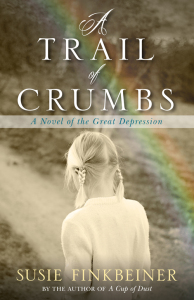 Susie Finkbeiner’s historical fiction series centers on Pearl Spence, a young girl growing up in the dust bowl during the great depression.
A Trail of Crumbs picks up exactly where Cup left off—Palm Sunday—known in the dust bowl as Black Sunday.
I won’t give anything away, but tragedy strikes the Spence family, sending them reeling both emotionally and across the country. We watch Pearl grow up as the Spences settle into a new community in Bliss, Michigan. (Go MI!)
The story is told in first person from Pearl’s perspective. The author uses Pearl’s child thoughts to build suspense and speak honestly in…
View original post 309 more words
Rules of the Great Depression: Do Without

For the past two days we’ve talked about the rules of the Great Depression.
- Use it up
- Wear it out
- Make do
And today’s is possibly the hardest.
Do without.
Sigh.
Do without.
There were many things folks went without during the years of the Depression. As unpleasant as that may seem, it couldn’t hurt for us to think about what we could do without…as painful as it may be.
- Eat at home: I know. I know. It can be so tempting to pick up something quick from the local drive-thru on the way home. And it’s okay to. But just not all the time. I crunched a few numbers and found that feeding my family of 5 at Chic-fil-a would cost nearly $40. To make a similar meal at home (which would yield leftovers) would cost me less than $15 (plus, it’s WAY healthier and I throw in some veggies as a side). It takes planning and a little creativity to cook at home. But if you cut one of your drive-thru escapades per week you could end up saving up to $100 a month! That’s $1200 a year. Adds up fast, huh?
- Meatless Mondays: This was an idea started during World War I (then called The Great War) to conserve meat so more could be sent to the troops in Europe. (It was actually Tuesdays for supper and one meatless meal the rest of the week making a total of 9 no-meat meals per week). It’s a great way to save a little on your grocery bill (and on your cholesterol total). Get your protein from eggs, beans, or dairy products.
- Sleep on it: Before you buy that big ticket item, give yourself some time to ponder it. Consider why you want that item and if you truly need it. Write out a pro/con list and do some research into the item (specifically check into the quality of it. It’s not worth buying if it isn’t going to last).
- Enjoy time at home: If you’re trying to keep expenses down you know how tough it is to afford a night out. So, be creative and figure out some cheap fun at home. Dig through the closet for the board game you haven’t played in 20 years, watch a dvd you just dusted off from the shelf, read a book out loud, or turn on the radio and have a dance party! (I have friends who run their own cooking contest with random ingredients from their cupboards!).
- Learn the art contentedness: It’s a beautiful thing when we can look around us and be pleased with what we have. When we aren’t constantly in the pursuit of more, more, more we are able to allow ourselves to feel a certain measure of peace. It’s extremely freeing when we can honestly say, “I’m okay with it and I’m okay without it” (that I got from Jeff Manion’s book Satisfied).
- Decide what’s important to you: During the Depression often the choice was between buying a pair of shoes or putting food on the table. They sometimes had to choose between paying the rent and getting medical attention. Not many of us are in such tight places as they were (although some are). However, when we say “yes” to spending money on one thing, we’re saying “no” to purchasing another. What we all have to do is figure out what it is that’s important to us and say “no” to those things which aren’t so important. Maybe that’s paying off bills or upping your giving to charitable organizations. Whatever it is, commit to going without the less important things so you can achieve your goals.
I’m sure you have some ideas of how to do without. I’d love to hear them! Or maybe you’ve been in a situation of having to think of creative ways to watch the pocketbook. Feel free to share below!

I’d love to extend an invitation to you! If you’re in West Michigan, I’d love to see you at Baker Book House in Grand Rapids for a book release party TOMORROW! I’ll be there talking about the Great Depression, giving away some fun prizes, sharing some snacks, and signing books. It should be a great time! Sign up for your free tickets HERE.
Rules of the Great Depression: Make Do

There were four rules of The Great Depression that helped folks make it through those tough economic times.
- Use it up
- Wear it out
- Make do
- Do without
Yesterday we talked about using up what we’ve got and wearing it out. Today, we’re going to discuss making do.
We live in a culture of disposables. Nothing is made to last anymore, not like they were back in the 1930s. In those days, things were made to be fixed at some point. Now they’re made to be replaced after a short while.
Another disadvantage we have is that we’re sold many items we don’t need. We’re told that we need the newest, the shiniest, the updated version.
Still, we can use this rule of the Depression to our advantage. Here are some ideas how:
- Learn to fix things (or marry someone who does): Our grandfathers knew how to fix their old jalopies regardless of what might have busted on them. Our grandmas could glue the handle back on a tea cup like a pro. Just because something was broken didn’t mean it needed to be tossed. If it could be fixed, they found a way. (NOTE: These days I drive a minivan that is over ten years old, it’s made it over 200,000 miles, and is rust red from so many Michigan winters. But when something breaks on it, my hubby fixes it. It’s paid off. We’re going to make it do until we have enough saved up for a new vehicle. NOTE #2: This is not to my credit. It’s all about my husband. He’s the coolest.)
- Make use of multi-purpose items: That vinegar in your kitchen? GREAT for washing windows. Baking soda? Fantastic for killing odors. Vicks Vapo Rub? Superb for healing those little cracks on your fingers from dry weather. When you can eke out more purposes out of what you have the value doubles!
- If you need something, make it: As far as I know there was no Ikea in 1930s America. Not even a Target or Walmart. If somebody needed a bookcase they got some wood out of the scrap pile, hammer, and used nails out of their old coffee can and put one together. If they needed a new shirt/dress/etc. they used the fabric from the flour sacks they got from the store. They used the materials they had on hand (or could borrow or trade) to make what it was they needed, saving them a mint. This is also GREAT when you want to give a gift! People love handmade things (just as long as they’re nice). Etsy is a testimony to that! (NOTE: My husband decided that we needed an antenna for our house since we don’t have cable. He didn’t want to spend between $40-$80 on one at the store, so he made his own! He used some scrap wood he had in the shed and attached old wire hangers all up and down it. Voila! Free! And it works great! NOTE #2: Again…my hubby rocks.)
- Play to your strengths: Don’t forget your number one resource! YOU! Folks in the 1930s were aware of their strengths and worked with that. They’d trade for services they needed (doctor visits, lawyer meetings, etc) with what they were skilled at (baking, gardening, child care, etc.). Know what you’re good at and make do with your skills. Don’t be afraid to learn something new, too. (NOTE: This is one reason I’m so glad that my husband and I have different talents. We’re able to work together to get things done for our home and family. Team work makes the dream work, friends.)
- Decide to be content: It’s a great temptation to get the brand new, the bigger and better, the newest and fastest. We want the newer house in the nicer neighborhood (which comes with a hefty mortgage). We desire the newest version of technology (which will just be outdated in six months). We can spend a whole lot of time and even more money chasing after satisfaction in things. BUT, we’ll be far happier (and better off financially) if we can decide to be content. This was something those in the Great Depression understood. They were able to be okay without the newest and shiniest. (NOTE: My pastor Jeff Manion wrote a great book about learning to live a life of contentment called Satisfied. It’s worth checking out if you’d like to find value in life aside from what we have.)
So, what are some of your ideas for making do with what you have? Any tips or tricks to share? I’d love to hear from you!
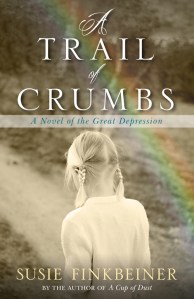 I’m excited about my newest novel A Trail of Crumbs: A Novel of the Great Depression which releases next week! You can pre-order today.
If you live in West Michigan, you’re invited to a release party at Baker Book House in Grand Rapids, MI. Get details and register for your free online tickets HERE.
Feel free to follow me on Facebook for more book release details and fun!
The Rules of the Great Depression: Use It Up. Wear It Out.

There were four rules to surviving the Great Depression:
- Use it up
- Wear it out
- Make do
- Do without
Folks in my soon-to-release novel A Trail of Crumbs: A Novel of the Great Depression (coming March 27…wink, wink) had to follow these rules in order to hold onto their hard earned (and often hard to come by) pennies and dimes.
With some economists predicting a recession in 2017 (sorry for the happy bubble bust), it might be good for us to look to our grandparents for ideas of how to make ends meet in tough financial times.
Here’s the first in a three part series. Hope it’s helpful (and a little fun)!
Use it up. Wear it out.
You’ve heard it probably a million times. Your mom or grandparents may have said it. Perhaps you’ve even said it yourself (then marveled at how like your mother you’re becoming).
Waste not, want not.
It’s a phrase that goes back as far as the 1700’s and essentially means that if you don’t waste it, you won’t be without it. Makes sense, right?
In the Depression era waste was seen as a shameful sin. They used what they had, every single drop or crumb or fiber. And they used it until it was threadbare and no longer usable.
See if you can use any of these ideas to take full advantage of what you have and, so doing, save some cash-o-la!
- Cook from your pantry: If you’re running short on grocery money, try cooking at least one full meal from the contents of your pantry. With only what I have in my house right now I could make soup, a few casseroles, and more mac ‘n cheese than any family should ever eat. Be sure that you’re aware of what’s in there before you run to the store. (NOTE: I’m horrible at this. I sometimes go to the grocery store three or four times a week for ingredients, spending far more than I need to and sometimes even coming home to find that I already have six cans of refried beans in my pantry. At one time I had five containers of cinnamon…oopsy.)
- Learn to love leftovers: Take them for work lunches or pack them for your kids to take to school, reimagine them into new meals (a roast can be shredded for tacos or cubed for soup). You’ll save so much if you think ahead when you cook to all of the options for what you have left. (NOTE: This is probably the only one I’m good at. Well, that is if my hungry kiddos leave any leftovers…)
- Compost it: Don’t toss food waste in the trash can when you can put it in a bin outside to decompose and turn into FREE fertilizer! (NOTE: If only I were organized enough to actually get a bin, learn how to make it so the compost doesn’t attract R.O.U.S., and were brave enough to try it. Maybe I’ll make my genius daughter figure it out.)
- Can and freeze it: Because your compost is SO AMAZING your garden will yield more veggies than you can eat in one season (either that or you hit a good sale at the farm market). Instead of letting it go to waste, preserve it! Google how to freeze (some things need to be blanched or sliced a certain way) or ask your mom to teach you how to can. You’ll be glad for that freezer full of zucchini and the pantry laden with stewed tomatoes in February. (NOTE: Yeah, I don’t really do this. My mom is my tomato lady and when I freeze things I tend to forget about them. Sigh.)
- Don’t throw it out if it can be used: Half used sheet of paper? Cut it up into scrap paper. Ziplock bags? Wash them out and hang them to dry for another use. Stale bread? Make stuffing or toast it to use for breadcrumbs. Grungy t-shirt? Cut them into rags. If it can be used for something then, by all means, repurpose it! (NOTE: I have a small home with limited storage. Saving every little thing for future use is just not practical. I’m more inclined to toss something into the recycle bin or the trash can. Sorry, Grandma!)
- Learn to mend: Oh, how many times I’ve thrown out a shirt because it had a tear or a pair of socks because there was a hole in the toe. The ladies of the Great Depression would have thought we were mad for doing such a thing. Most of them had what they called a “mending basket” full of to-fix clothing items. They darned socks, patched up jeans, and even stitched up their nylons. (NOTE: I need to up my mending game. I’m horrible. Even sewing a button on a shirt overwhelms me. My kids have learned that if they want something mended they need to wait for Nana {my mom} to come over. Sigh.)
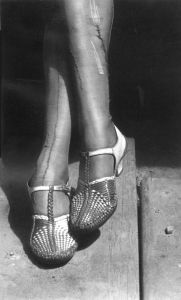
Mended Stockings (1934), photo by Dorothea Lange
So, you’re ready to get every little inch of value out of your purchases? Great! Have any of your own tips (or ones you learned) for using up what you already have? I’d love to hear about them in the comments!
Catch more Depression Era tips and tricks here on the blog. Subscribe so you don’t miss a post!
Also, don’t forget A Trail of Crumbs releases next week. If you’ve never read A Cup of Dust (the first book in the Pearl Spence series) now would be a good time to get your hands on it!
I found home here.


From the day I moved into the college dorm my freshman year until the day of my wedding I lived the life of a nomad.
From dorm rooms to summer housing on campus to an apartment to a spare room to sharing a room with a six year old (who is turning 20 this year…yowch), I moved around a whole lot. Some days I wondered why I ever unpacked my boxes just to load them up again after a handful of months.
I went years without having a place that truly felt like home.
But then after my wedding I stepped into the home my husband had bought for us. I remember standing in the living room, knowing that I didn’t have to move any time soon. That I belonged in that house.
I’d found home.
In A Trail of Crumbs, Pearl and her family are uprooted from their home. They have to travel over a thousand miles away to stay in the spare rooms until they can find a place of their own.
It’s in this book that you’ll meet Gus Seegert (you’ll love him, I just know it). At one point he speaks of why he never went back to where he was from after so many years of being gone.
“I found home here,” he says.
When I typed those lines for Gus, I had the same anchored feeling that I experienced the day of my wedding. And I feel it again as I sit here writing this post.
I found home.
And it’s amazing.
What about you? Do you remember ever having a concrete sense of home? I’d love to hear your story.
11 Facts about Black Sunday

If you read A Cup of Dust you know that the story ended on Palm Sunday, 1935. All seems well. Sunny, bright, blue sky, the dust is over.
If, however, you know the history of the Dust Bowl, you are aware that the day didn’t end the way it started.
A Trail of Crumbs (releasing March 27) picks up Pearl’s story right where A Cup of Dust left off, April 14, 1935. A day also known as “Black Sunday”.
Want to know more about that day, the setting for the beginning of my new novel? Here are 11 Facts.
- On that day many people took advantage of the clear day to go on picnics, visit family in neighboring towns, or air out their houses. The people affected by the dusters (living in states including Oklahoma, Texas, Colorado, New Mexico, and Kansas) believed that they’d seen the end of all dust storms. They decided to celebrate.
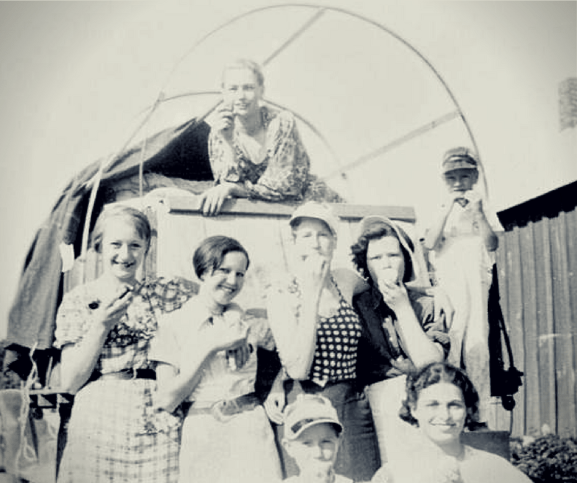
Photo by Dorothea Lange, Library of Congress, Historic Adobe Museum - By 4:00 pm the skies turned black. The monstrous dust cloud came barreling on them without warning. Some even said the sky above the black “roller” was bright blue and that the sun shone as bright as before high in the sky.
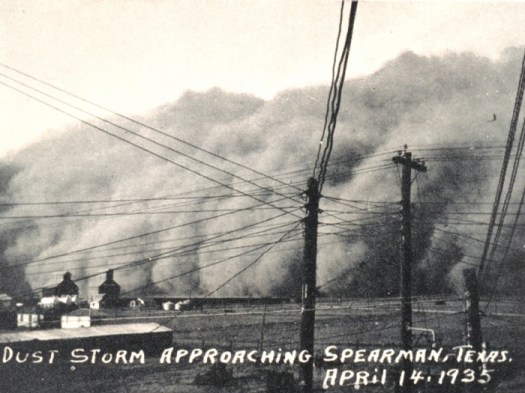
US National Oceanic and Atmospheric Administration, Public Domain - The high winds reportedly displaced 300,000 tons of topsoil. That’s 461,538 African elephants. Or 150,000 minivans. Or 3,141,361 men of average weight. Friends, that’s a lot of soil churning and turning over everything.
- The cloud was over 1,000 miles long. That’s 182 Mount Everests. Or 17,600 football fields. Or the distance from my house to the town where Stephen King lives (not that I’ve mapped it out or anything).
- Winds whipped that soil at up to 100 miles per hour.
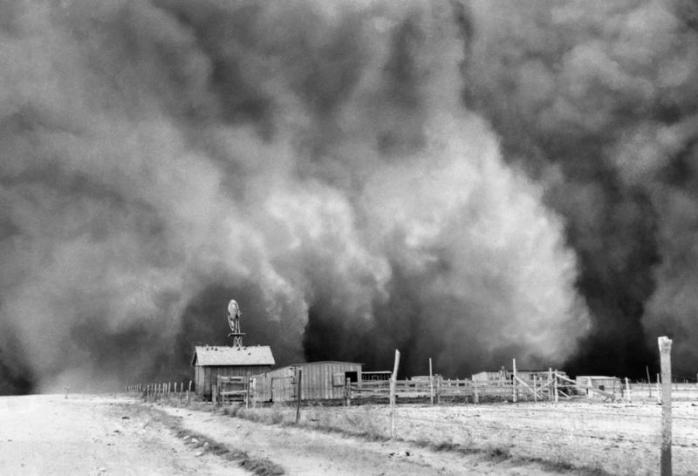
Courtesy of the Associated Press - The swirling dust built up static electricity. Folks had to drag a chain behind their cars to keep the battery from shorting. The barbed wire fences glowed blue with electricity. People shocked each other when they touched.
- The storm submerged the entire region in darkness so thick, you couldn’t see your hand in front of your face. Hens, thinking it was night, went in to roost in the middle of the day. Eyewitnesses said they couldn’t see the street lights or even their hand held up in front of their face.
- Many people were stranded away from home. They took shelter in abandoned homes, their cars, or with kindly strangers. Some even formed a human chain, holding hands and leading each other to safety.
- Of those who survived that day, many came down with “dust pneumonia”. Much like a coal miner’s “black lung”, this was a build up of dust in the lungs, leaving the sufferer with lifelong asthma and other respiratory ailments.
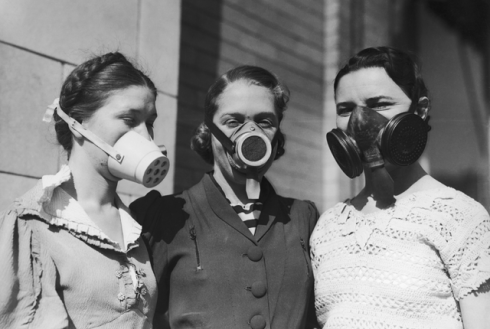
Masks worn to protect the lungs from the dust. Courtesy Getty Images. - This storm earned the region national attention. The dust blew all the way to Washington D.C. where it fell on members of Congress as they met to decide whether or not to pass soil conservation legislation to help the people caught in the plague of dust. They did, indeed, pass that bill.
- It earned the region the title “The Dust Bowl”. Robert E. Geiger coined the title in his report for the Associated Press on the storm. Fun fact: It may have been an error. Some thought he meant to call it “The Dust Belt” instead.
Have any questions about that day (or anything during the Dust Bowl era)? Go ahead and write it in the comments below. I’ll do my very best to answer!
To learn more about the Dust Bowl, check out Ken Burns’ documentary The Dust Bowl or read Timothy Egan’s The Worst Hard Time.
You can order the Pearl Spence novels from Baker Book House.
4 Ways Depression Era Housewives Were Tougher than I am

It’s no big secret. I’m not the world’s best housewife. But when compared to the housewives of the 1930s? Oh, please. I’m like a little slug compared to them.
I did a good deal of research into what life was like during The Great Depression for the Pearl Spence Series.
The women of that era? They were tough. Tougher than I’ll ever be. Wanna know how? Here are 4 ways.
- They washed their dishes by hand and with just a dot of soap: Full disclosure, I whine because I have to rinse my dishes before putting them in the dishwasher that rolls across the floor. Depression Era ladies? Yeah, no dishwasher. They scrubbed those pots and pans shiny with just a rag and a tiny drop of soap.
- They made and mended their own clothes: I can’t sew a button on a shirt. These women made full wardrobes for their families out of feed sacks, darned all the socks, hemmed and mended and otherwise fixed EVERYTHING. And they looked good while doing it.

- They went without to make sure the kids had enough: Okay, so I have a stash of chocolate that I hide from my children and husband (hee hee, hi, honey). Depression Era Mamas? Nope. They got used to having too little so their kids wouldn’t starve, so their husbands had what they needed. Man alive, these ladies are really proving that they deserved that greatest generation title, huh?
- Birth without doctors: In the 1930s women were still delivering their babies at home, many with the help of midwives (women who attended the birth). No heart monitors, no mechanized bed, no ice chips, and NO EPIDURAL. Me? I called my doctor with every twinge I had in my first pregnancy. I made someone spoon feed me lime Jell-O between contractions. I took the meds, oh yes I did. Geesh. I’m looking more and more like a wuss!
And what amazes me most about these women is that they weren’t just tough, they were also kind. The women of the 1930s are remembered as compassionate, caregiving, generous, loving, nurturing, faithful ladies. They were strong because they had to be. Resilient because it was required of them.
Oh, how I look up to them.
-

Wikimedia Commons
Finding friends in books.


I remember the first time I read To Kill a Mockingbird by Harper Lee. I was in eighth grade and going through a rough time. My best friend had just decided that she didn’t want to be my pal, let alone my best one. I had a terrible perm, out of style clothes, and a whole headful of insecurities.
But there on the page was a girl who was every bit what I’d been when I was younger. Plucky, brave, and with a side of sass (which I’d never released upon the world but kept in my head). Scout felt like an instant friend.
That same year I read The Outsiders by S.E. Hinton. Ponyboy and Johnny were as different from me as they were from the “Socs”. Still, their vulnerability, their love of Robert Frost, their depth of sadness was so very familiar.
The next year I read The Scarlet Letter and wept over the horrible treatment of Hester and Pearl. I wanted to scoop them up out of that awful town and help them find a place where they would be loved and afforded mercy.
From those days of early teenage life to today I have found countless friends within the pages of fiction. Owen Meany and Luna Lovegood, Jem and Merinda, Doug Swieteck and John Coffey. Reading their stories (and the stories of hundreds of other characters) remind me that I’m not so alone in this world.
Reading these stories makes me feel at home.
In A Trail of Crumbs (releasing March 27) eleven year old Pearl’s mother tells her to go out and make friends soon after they move to a new town. So, where does Pearl go? To the library, the place where all bookish kids go to meet new friends.
And there she does. Not just of the fictional sort, but also of the kindly librarian type.
Readers bond together, quietly, over dusty tomes. Don’t they?
And as we grow in these friendships – both in real life and in fiction – we learn that life is truly a beautiful gift. And we share in the story of this life.
What fictional characters are like friends to you? Which ones do you come back to over and over to feel that connection, that kinship? Do you have bookish friends you like to talk story with? How have you bonded over books? I’d love to hear from you. Your story matters.
5 Depression Era Tricks for Saving on Groceries

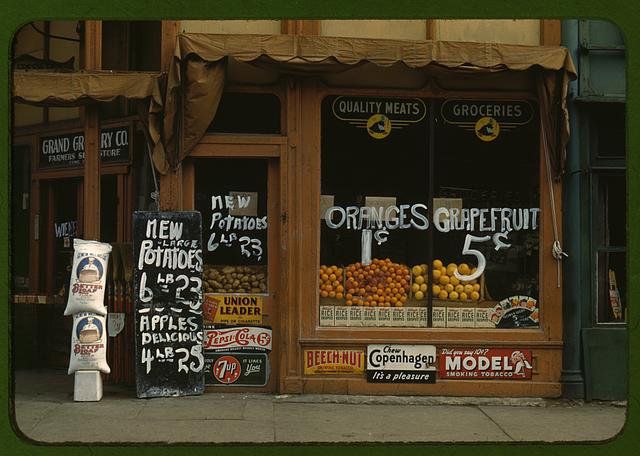
I consider myself a frugal shopper. I clip coupons, compare prices, shop the sales. But my accumulative savings are nothing – NOTHING – compared to the housewives of the Great Depression.
While researching for the Pearl Spence Novels, I learned how the women of the 1930s managed their shopping budgets during those tough economic times.
Those ladies put me to shame!
They knew every trick to skimp and save. They pinched every penny as if their lives depended on it. Why? Because, quite literally, their lives (and the lives of their families) did depend on every penny saved.
So, how did they do it? How did they make the most of their grocery budget?
Here are 5 Depression Era Tricks for lowering that grocery bill.
- Buy the whole chicken: Our grandmothers never, ever would have bought chicken breasts. She would have been disgusted to pay nearly $4 per pound for boneless/skinless chicken breasts when she could get a whole chicken (skin, bones, and all) for $1.05 per pound (by today’s prices. In the 1930s she would have paid 22¢ a pound). Oh, the meals she could get out of that chicken. Chicken and dumplings, fried chicken, chicken soup, chicken sandwiches…you get the point. Chicken for DAYS!
- Less meat. More filler: With ground beef about 10¢ a pound, our grandmothers would have thought of the very best way to make it stretch. She would have used filler to make a little meat seem like a whole lot more. Oatmeal, lentils, bread crumbs – all perfectly good things to add to meat to make it stretch. It’s also a great way to get more veggies into your diet! Add some diced onions and green peppers!
- Buy the cheap coffee: My grandma swore by cheap coffee. She was an instant crystals kind of girl. The bad thing about cheap coffee? The flavor. It can be overly bitter and just plain old skunky. So, what did grandma do? She’d add a pinch of salt to the grounds before brewing. The salt takes the bitterness out and makes for a smoother cup of mud. (Still, there’s no way…I’m too snobby about my coffee)
- Work the system: The Depression Era housewife knew how to play the system. She knew to get her fresh foods (produce, baked goods, meats) on Saturday evenings when they’d be steeply discounted for the end of the week (grocers were never open on Sundays). They knew to ask for soup bones because they could get them for next to nothing if not free. You can work the system, too! Sign up for the rewards programs at your grocery store, figure out when items are most likely to go on clearance, stock up on nonperishables that are on sale (bonus points if you have a coupon!). But be sure to only work the system for things you need/would usually buy. It’s not a good deal if it sits on your shelf collecting dust for a year.
- STICK TO YOUR LIST: When my grandma got older she wasn’t able to shop for herself anymore. She’d send my sister and me to the grocery store with a list and a stack of coupons. If we deviated from the list – oh, doggy – were we in for it. Why? Because the off-the-list items were almost never on sale, weren’t needed, and usually ended up being potato chips/ice cream/chocolate. If you take the time to plan your list and stick to it, you’ll save money in the end. No kidding.
How about you? Any tips for saving the big bucks at the grocery store? Any bits of wisdom you learned from a grandma/aunt/grandpa/parent? I’d love to hear them!
Learn more about the Great Depression! Read the Pearl Spence Series. The final book in the set, A Song of Home: A Novel of the Swing Era releases soon! Preorder it today!
 susiefinkbeiner.com