My Two Secrets — a guest post by Jocelyn Green (and a give-away)

When I began writing Spy of Richmond, I had no idea I’d learn for myself what it meant to keep a gigantic secret from everyone I loved. My heroine’s secret, of course, was that she was a spy. My secret? My husband had cancer.
We thought it was just a lump on his clavicle. A very painful, swollen, hot-to-the-touch and out-of-nowhere lump. Even as they wheeled him into the operating room to remove it, the word “tumor” did not occur to me. So when the surgeon came to consult with me afterwards and said the tumor was too large to remove, I was completely caught off guard.
“We’re sending a sample to the lab,” he told me, “but if I were you, I’d want to know what we’re dealing with here. Hodgkins Lymphoma cancer.”
I jerked backwards, as if his words had slapped me across the face.
“I see this all the time,” he continued. “It’s a textbook case.” More words. Chemotherapy . . Meet with the cancer team on Friday to get his treatment plan together. . .
I was crying by now. “Are you going to tell Rob? Am I supposed to tell him?”
“No, I don’t want to tell him until the labs are in. But you need to process this now so you can support him when the time comes.”
Well, if I wasn’t to tell Rob, then I wasn’t going to tell anyone. This was my first secret.
I went through the motions of life, holding the ugly news close to my heart until it bore a hole right through it. At the pharmacy, picking up Rob’s post-surgery prescriptions, I couldn’t bear to answer the cheerful question, “How are you?” On Facebook, someone asked Rob if the doctor said anything about cancer. Rob said no. My secret gnawed through my middle.
Then the phone call came: no cancer cells were detected. The mass was completely benign. This was the first time the doctor had been wrong, the nurse told me. I was stunned. After I hung up the phone I told Rob, “It isn’t cancer,” and started sobbing. “They told me it was cancer,” I choked out. It felt like a miracle to me, and suddenly the only thing that mattered was that Rob was going to be OK.
Still, recovery from that surgery was very challenging. Because of the depth and width of the incision, he needed follow-up appointments at the wound care clinic for weeks, and I was in charge of changing his dressings a few times a day at home, which was painful for him, and distressing to me. Add to this the fact that he developed a dependence on his narcotic and went through a terrible withdrawal.
A month or so after Rob’s surgery, our family took a mini-vacation, and I cracked my toe on a deck chair at the side of the hotel pool. Really hard. It hurt like the dickens, but I wasn’t about to complain. After all, look at what Rob is still going through! I thought. This is nothing. So we carried on, walking around the Science Museum that night and around the zoo the next day. My toe was killing me, but since it was nothing “compared to Rob,” I tried to deny the pain.
Weeks later, I still was limping. I finally went to the doctor, where an x-ray revealed I’d broken my toe. This, then, had been my second secret, one I had tried to keep even from myself. The truth of the matter—my secret—was that I was in pain. The lie that I had chanted to myself to drown out the truth, was that because my pain was less than someone else’s, my pain was invalid, and did not deserve attention. The lie was that acknowledging my own pain would be a wimpy thing to do.
Don’t we all deny our own pain sometimes?
But here’s the thing about pain, whether it’s physical or emotional. It’s real, even if/though someone else is currently suffering more than you are. Comparing burdens is useless. Pain is a sign that something is wrong. And only when we acknowledge that something is wrong will we be able to fix it.
I have this hunch that at least some of you are experiencing pain today. Hear this: your pain is real, and you are not weak for seeking help. What you’re feeling is valid. Don’t tell yourself that because someone else has it worse, you should be fine. C.S. Lewis once called pain the gift that no one wants. Pain is a message that we are not whole, and that we should be. Pain says something needs to change in order for us to feel better. But we have to be honest about it before we can get on the path to healing.
It’s a delicate balance, but one worth striving for. Let’s be grateful for the blessings we do have, but please, let’s not walk around on broken toes.
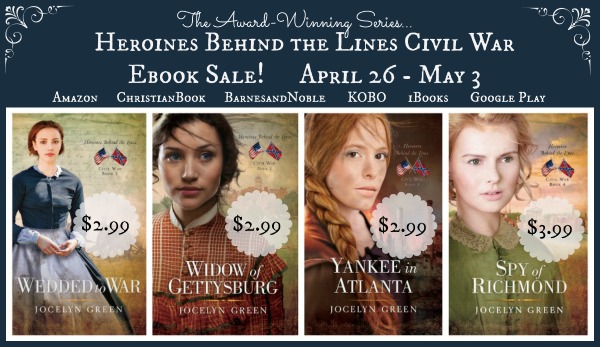
Don’t Click Away Just Yet! Jocelyn has offered to give-away one of the Heroines Behind the Lines books to one lucky reader. You pick the book (see the graphic above for the titles) and if you’d like a digital or paper copy. All you’ve got to do is tell me in the comments which you’d choose. I’ll pick a winner on Sunday and announce it on the Monday blog. Ready? Steady? GO, Eddie!
They Never Saw Stu Redman Again — or — 3 Things Storytellers Can Learn From Uncle Stevie
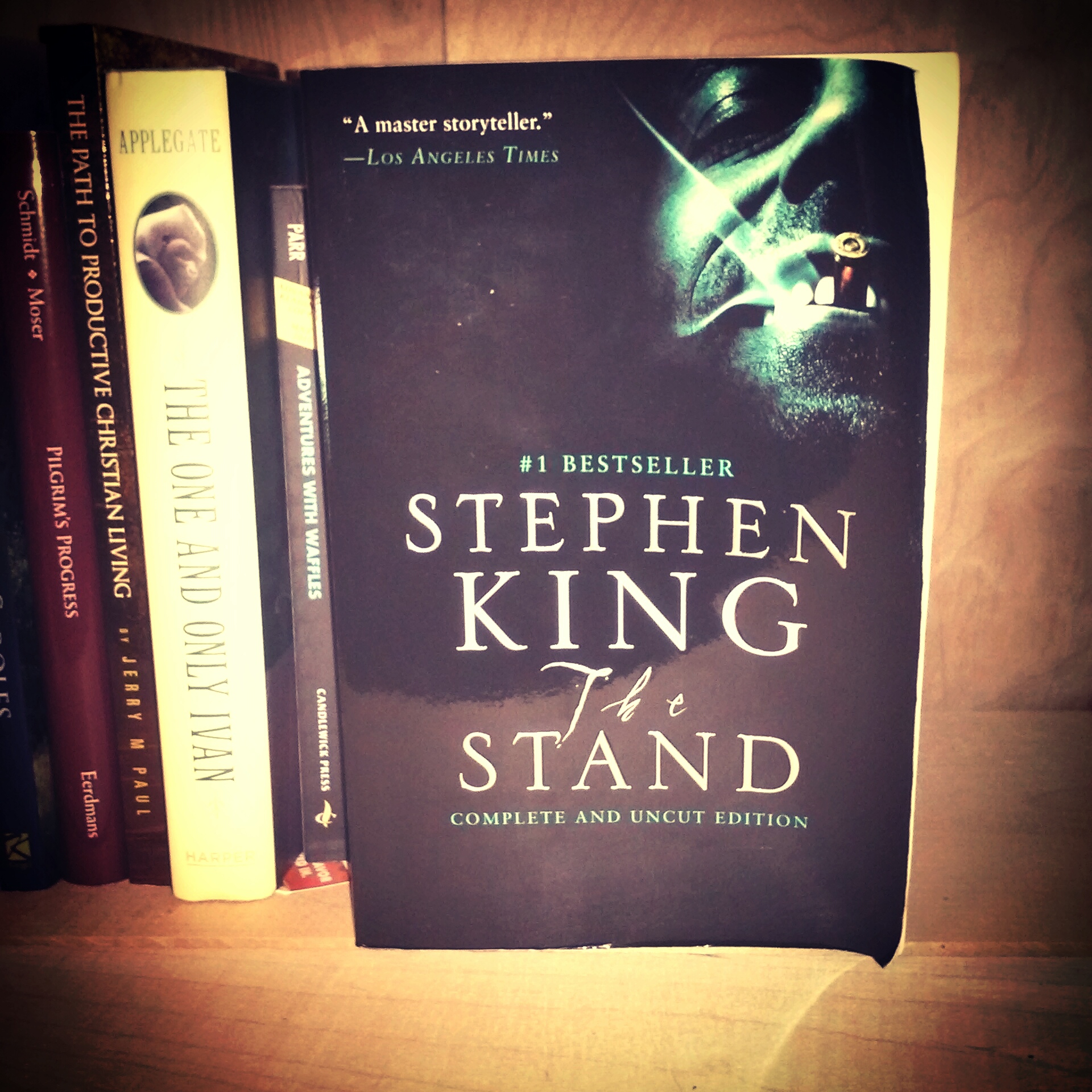 Now, I’m well aware that Stephen King isn’t everyone’s favorite flavor. That’s fine. No biggie. I’m not here to discuss his merits as a Great American novelist.
What I will argue is that the man knows how to write a novel. He can spin a story, sustaining momentum on each page to keep the reader from wanting to close that book.
How does he do it? Well, you’d have to read his memoir, On Writing, to learn that. However, after reading The Stand, I’ve come up with 3 things storytellers can learn from Uncle Stevie.
1. Don’t be afraid of seeming a little weird: Stephen King has a personality all his own. He’s got a creative way of slapping down a sentence. But that’s not all that one could see as weird. I mean, King comes up with some strange folks to populate his novels. Weird things happen to them. A lot of people think Uncle Stevie has one warped mind on him. They think he’s a little off. But giving into his wide creativity without fearing that people will think he’s an odd duck has not only filled his bank account, it’s allowed him to put together some of the most imaginative (and terrifying) works of fiction in modern literature.
2. Set up the reader’s expectations. Then knock those expectations to the ground: It’s the old bait and switch. Build up the idea that one thing will happen then…KABLOOOEY…shake it up. Don’t be afraid to do this several times. King certainly isn’t. For instance, “They never saw Stu Redman again”, causes certain expectations in the reader. King carried through with that sentence, but not in the way I would have guessed. KABLOOOEY!
3. Make them confused about how they feel about that bad guy: In The Stand, Randall Flagg is one bad dude. It’s established from the beginning. The guy is pretty much satan. But, let me tell you, there was one scene which was written SO EXPERTLY that I doubted if he really was bad. Uncle Stevie tricked me! Made me feel the way the other character in the scene felt: confused. This makes for good conflict, right? It makes for a 3-D antagonist (bad guy). I love that.
What have you learned as a storyteller from an author you admire? How about things you’ve learned NOT to do from reading?
Just Another Brick (or rock) in the Wall
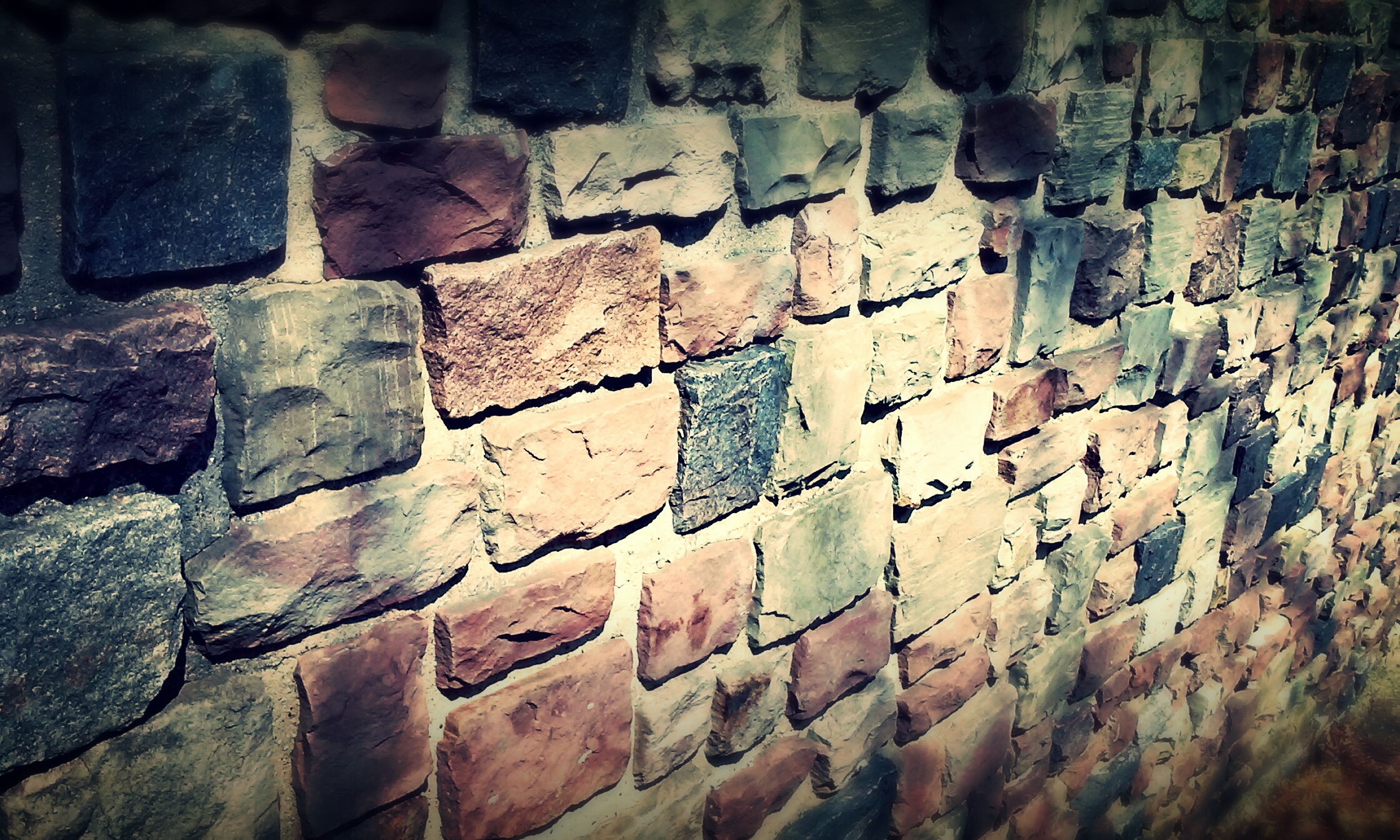
I’ve always been fascinated by rock walls. They are big puzzles really. I love the different kinds of rock, the way they fit together, how the colors work together. My dream house would have a rock exterior.
When I see a rock wall (like the one in the picture I took at John Ball Zoo…this one is up on a hill, up a kazillion perilous steps, but worth the hike) I think about the work it took to put it together. The planning, the blood blisters (did you know I have an irrational fear of blood blisters?), the worn-out-back work of lifting all the rocks. I am awed by the craftsmanship it took to construct such a thing of use and beauty. If well maintained, those walls last a good long time.
The other day I printed out the first three chapters of the book I’m writing. I pulled out my trusty purple pen and grabbed a cup of coffee. Editing time.
For me, writing the first draft of something is like gathering the rocks and putting them into a pile. Editing is figuring out, over several swipes, which rocks will work and where they’ll fit best. It’s a process which cannot be rushed. It takes concentration. Sometimes a scene or character I thought was absolutely perfect just will not fit. I save it for another wall that I’ll build later on.
In my experience, novel writing is like building a wall with the hopes that it will be both useful and beautiful.
Luckily for me, writing doesn’t usually result in blood blisters.
Mrs. Clumsy Needs to Balance
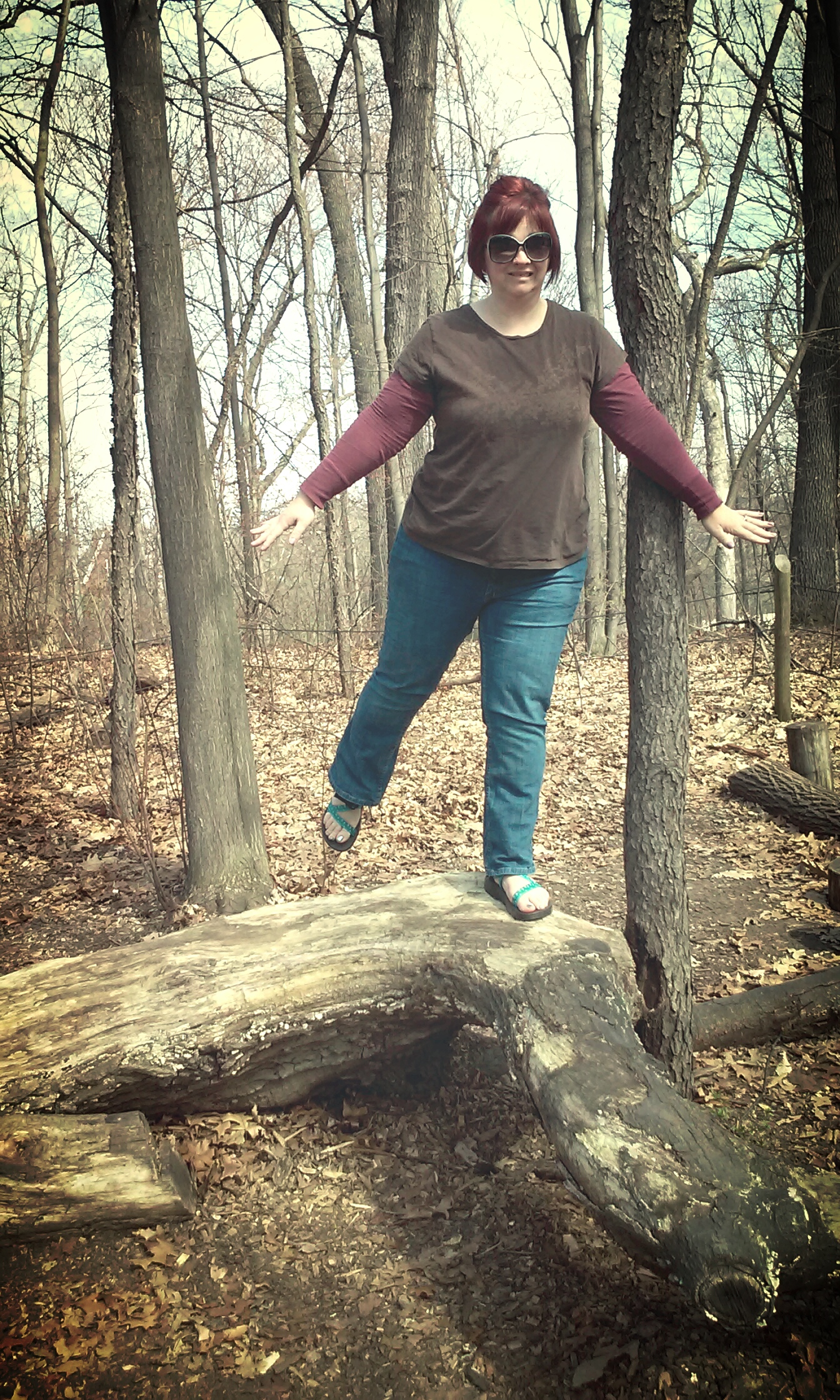 This is me. I’m trying to balance on a log. This, my friends, is a dangerous endeavor.
I am Mrs. Clumsy.
When I was in the hospital, recovering from a c-section, I had a bracelet that said, “Fall Risk”. Yeah. Tell me about it. I asked if I could have a dozen of those bracelets. The nurse laughed. My husband assured her that I was serious.
I fall down a lot.
What I need is to work on my balance.
Let’s just say that I can be clumsy in my life, too. I forget things. I biff on getting the dishes done or putting the laundry in the drier before they stink. I try to fit too much into a day, ending up feeling overwhelmed and unable to accomplish half of what I want to.
I fall down a lot.
I need to work on my balance.
You may have noticed that I skipped writing a blog on Monday. Sorry about that, pals. It just couldn’t get done. When I contemplated staying up super late on Sunday to write one, I realized that it was no big deal. I could exercise a little balance. I could put it off.
Guess what? The world continued spinning. No one got hurt. Monday was still Monday (albeit a windy, wet one). And my writing career didn’t fall into the abyss of failure.
I don’t know what Spring looks like for you. For me it’s a lot like chaos. End of school festivities, speaking engagements, deadlines, my boys turning 7 (I will be okay…it will be all right…I’m not getting old…they’re still my babies…WAHHHHHH). Now is the time for me to carefully consider how I balance.
Honestly, I’m not exactly sure what that means yet. But I’m going to ponder if there are some things that need to go in order for me to maintain balance. Also, which things need to receive more of my attention so I don’t teeter and fall.
This is where you come in. How do you keep balance in your life? Or, if you fall a lot like I do, what might help you?
Building Tension
Someone asked me once what my “reading guilty pleasure” was.
I had to think about that. Did I feel guilty about any of the books I read? Well, not really. Do I ever feel guilty about spending my time reading? Nope.
So, I reframed the question. What was something I enjoy reading that others might not expect of me? The answer was automatic.
Stephen King.
I love reading books by Uncle Stevie (as he refers to himself in On Writing: a Memoir of the Craft). Yeah, he uses cuss words (including the big F-Bomb). Sure, there’s…ahem…scenes of intimate nature. Of course there are creepy, scary, terrifying baddies. But there’s also darn-tooting good storytelling in those 800-1500 some pages.
Also, reading his books in hardcover is a good arm toning workout.
 Currently I’m reading The Stand. The edition I purchased with a gift card (Thanks, In-Laws!) happens to be un-cut. In other words, all the stuff that got edited out from the originally published book was put back in by good old Uncle Stevie and rereleased.
Here’s the thing about Stephen King; he writes forever-long books, but he has become a master of sustaining tension throughout. He gives just enough ka-pow to keep the reader going because he promises to give a bigger bang later followed by an even bigger bazinga later on.
King is the…well…king of building tension. He writes with restraint (in that respect, at least). He is a brilliant storyteller, regardless of what one thinks about his books.
Reading Uncle Stevie’s books – whether it be Hearts in Atlantis, The Green Mile, 11/22/63 (holy hannah, was that a good one), etc – I become better at building tension in my stories. Of sustaining it throughout the storyline so that the core is firm and not flabby.
Now that I think of it, reading his books is like an ab workout. Hm. Maybe I should use his books as a weight the next time I do crunches…
Do you read Stephen King books? If not, that’s cool. We can still be friends. What other authors/musicians/artists/scientists inspire your work?
3 Reasons I NEED a Deadline
 Yesterday afternoon I had a conversation with my agent. We do this often to gauge where I am in my career, plan for the future, and talk about life in general (because she’s not only my agent, she’s my friend and I think she’s pretty fantabulous).
At one point in the phone call I said, “Give me a deadline.”
We set two. One for when the proposal and sample chapters will be done (because that’s what she’ll send to a publisher). Another for the day the book is done. Finished. Polished and shiny.
May 25 and November 16.
I felt relieved, having those dates set and scribbled on my planner. They are concrete. Written in purple pen (so you KNOW that means business).
See, I’m a person who NEEDS a deadline. Why?
1. Because I’m apt to goof off otherwise: If I don’t have a countdown to when I need to be done, I can justify all kinds of tomfoolery. Catch up on Mad Men (they just put another season on Netflix). Go on Buzzfeed to find out which Disney Princess I am (Belle…always, always, always Belle). Go over to Goodreads to see how many people marked A Cup of Dust as “Want to Read” (can you pretty please go do that??? Plug, plug). Yada, yada, on and on. A deadline is the mother who stands over the kid working on homework saying, “You can’t play ’til you finish you math…”.
2. It’s a challenge: Now, I’m not the kind of person to climb a mountain just to see if I can. Nuh-uh. I get dizzy sitting in the stands of a basketball game…a high school basketball game. In a very small town with 4 rows of bleachers. Where was I? Oh, yeah. Challenge. Although I’m not one for physical challenges, I do like intellectual ones. Having a date by which I need to finish a novel (and have it be good enough for consumption) is a challenge. A game.
3. I need a keeper: Now, if I set a deadline myself, I’m likely to break it. I’ll ignore the date, pretend I never thought of setting it until I can turn the page on another month. However, if my agent or a publisher sets the date, whoa doggie, I’m going to work my tuchas off. The accountability spurs me on.
So, now that I have deadlines, I’d better get back to work. No more goofing off for me (well, less, at least).
How about you? Are you someone who thrives on a deadline?
Queen of the False Start
 I ran track my freshman and sophomore years in high school. Now, why would an asthmatic who abhors running join the track team? Two reasons.
1. My sister, Betsy, told me to.
2. Hello. It was a boy/girl sport. And, as evidenced by this picture, the boys totally bowed down to me and my sweet Umbro shorts.
Ahem.
Anyway. My freshman year I was put on the 800 meter race. If you don’t know much about track, the 800 is pure, unadulterated torture. It’s a twice-around-the-track sprint.
Did I mention that I have asthma?
Each Tuesday and Saturday as I got ready to run my event I was anxious to just get the horror over. Standing on the starting line, my stomach would flip flop, my palms would sweat. I was sure my heart would pound all the way out of my chest.
And that man would stand, the starter gun over his head. Anticipating that bang, I’d trip over the line.
False start.
Geesh.
~*~
I’ve written three and a half novels now. And, just as that nervous girl standing on the starting line at a track meet, this grown up novelist experiences false starts every now and then.
This novel I’m working on is no exception.
You may remember that I recently lost 8,000 words of the first draft. Well, I’m happy to say that I’ve rewritten those words (and I do believe they are better than the originals) plus 3,000 more.
Just this evening, after spending the better part of the day writing (don’t worry, I went to church last night), I realized that I had a false start on my hands.
Often, books on writing will say just to power through, get it all out before you fix it. From Once upon a time to They lived happily ever after without turning back to see what’s behind. Okay. That’s good. That works…sometimes.
And sometimes it doesn’t.
Guess what. That’s all right.
I personally own no less than 25 books on writing (probably more, I just don’t want to get up and count). Every single one of those books has a different idea for how writing works. Why? Because each writer has a different process.
One thing I’m learning? Every novel requires a different process.
Mine, at least.
And that, my friends, is perfectly fine. And I’m feeling great about it.
So, here I am, recovering from tripping over the starting line prematurely. I’m back in the blocks, trying to hold my balance until I hear the shot that tells me that it’s time to run.
Sweaty palms, pounding heart, nervous stomach.
I’m ready.
The Path to Productive Christian Living
Have you ever gotten a message/note/email that made you feel all kinds of honored?
I did a few weeks ago. It was from Jerry Paul. He was the president of my college (Great Lakes Christian College) for the first few years I attended.
His message? He’d written a book because he was inspired by my writing and publishing life.
Well, that was exciting for me to hear. Then, he offered me a copy of the book as a “thank you”. I didn’t feel like I’d done so much, but I’ll always take a free book, especially when I know that it’s going to be a good one.
 Last week, I read Jerry’s book The Path to Productive Christian Living and was not disappointed. He’s a good writer and I could hear his booming voice as I read. He wrote about The Sermon on the Mount and I believe this would be a good book to be read in a small group/Sunday school class/Bible study as a companion to the Scripture.
It was a good book for me to read around Easter, reminding me of the ways Christ calls us to live as His followers. I was encouraged and challenged and caused to ponder. Jerry wrote in a way that didn’t make me feel twisted around and confused (like some theology books have a way of doing). His writing was accessible, which I truly appreciated.
Another reason I gained so much from this book is because I know Jerry M. Paul has lived a life on this journey to follow Christ. He’s a humble man who is full of grace (I received that grace and a bunch of mercy after I dinged the bumper of his pristine car while in college). He is wise and encouraging. He truly loves Jesus and the Word of God. In his book, he offers the gift of his life experience.
I’m glad to know Jerry M. Paul. I’ve always looked up to him. And I’m happy to have read his books, his offering of encouragement to readers.
What’s a book that has encouraged you or made a difference in your life?
Raising the Hoop
When my boys were small, they were given a made-of-plastic basketball hoop for their birthday. At the time, the lowest notch was the perfect height for them to toss a little ball into. It seemed impossible that they’d ever grow big enough for the tallest level.
Welp. I just looked outside. My nearly 7 year old boys are shooting hoops (even making some of them) with the hoop as high as it will go.
My first thought? How did they get big enough for that?
My second? I truly admire that moxie.
(Fun Fact: my cat when I was a kid was named Moxie. That darn critter bit me nearly every single day. My mom used to tell me it was because he wanted to play. I just thought he was a jerk.)
You know, those boys could have left that hoop lower. They would have made more baskets, wouldn’t have had to chase so many wayward balls after they brick off the backboard, could have saved their arms a little from the effort of tossing the ball higher.
But they wanted it to be a challenge. They wanted to grow in their skills.
That’s grit. That’s character. I’m proud of them.
There have been times in my life when I’ve just wanted to keep things easy. Growing is hard work. Learning something new or taking it deeper is exhausting.
It ups the risk for failure.
That, my friends, is scary.
But, if we never go for it, we won’t get better. We won’t improve. We won’t grow.
I don’t know what it is for you. If it’s some art form or a different level of math (which takes true determination, if you ask me). Maybe you want to read a book that seems a little deep or thick or wordy (Moby Dick, anyone?). Maybe you want to learn a new skill or try a different sport. Whatever it is, you will grow – inch by inch – if you keep challenging yourself.
If you don’t, you might just stagnate. Grow bored. Give up.
This is a challenge to myself just as much as anyone else. In my writing, my family life, my physical activity (read: working out).
What is it for you? I’d love to hear what you’d like to grow in.
Dorothy’s Cross

Dorothy was the kind of relative one needs a chart to understand. Married to the cousin of my grandmother. She seventy. I seven. She the giver of baggies of treats, cans of coke, sweet smiles. She the scolder when her sister told tales of Gypsies coming to take naughty children away.
They lived in an old farm house in Blissfield, Michigan. Green forever. Tractors rumbling. Dirt roads for miles. For this city-born-and-bred girl, the country was magic. I needed no unicorns or fairies. All I needed was a visit to Blissfield.
In her room which was of white bedspread, wood floor, old furniture, the curtains always seemed to dance, the breeze playing with them through the open windows. On the wall beside her bed hung a cross. Not like a cross in my Methodist Church. Dorothy’s cross didn’t have the red flame of the Holy Spirit flickering around the wood. Dorothy’s cross had Jesus, still pinned to the bars.
I didn’t like to look at Dorothy’s cross. Jesus only wore a cloth around his middle, it draped in a way that embarrassed me. Red dripped from curled-up hands, flattened feet. The deep-carved gash in His ribs put a pain in my side. I didn’t like to look at Dorothy’s cross. But the sadness on His face held me. I’d struggle up onto Dorothy’s crisp, white bedspread and look at Jesus until my mom called me to go on outside or to sit and visit for awhile.
I’ve heard it said that Protestants don’t have Jesus on their crosses because they train their eyes on Easter. Jesus didn’t stay dead. He came back. Christ the Lord is risen today! Ha-ah-ah-ah-ah-le-e-lu-u-ia!
That’s good. It’s right. Christ had the victory over sin and the grave. We rush past the pain and betrayal and forsaking, the rending of the skies and Temple curtain. We trample over the grieving Mary and the scattering disciples.
It’s Friday but Sunday is coming.
Yes. It comes. But don’t skip ahead. Today, this Good Friday, is every bit as important as the third day, the coming Easter.
Today I remember the thorns jabbing his scalp and the nails impaling his palms. I remember God’s back turned to His beloved because the darkness of sin on Him was too rancid. I remember that Jesus, in taking our sin, absorbed it into Himself: the hate, the lies, the bitterness, the abuse, sin too ugly to think on. I remember He called out to His Father who did not answer.
Today I remember Dorothy’s cross. My feet dangling off the edge of her perfectly made bed and my eyes looking at Jesus’ feed suspended by a nail driven into a crudely made cross.
 susiefinkbeiner.com